

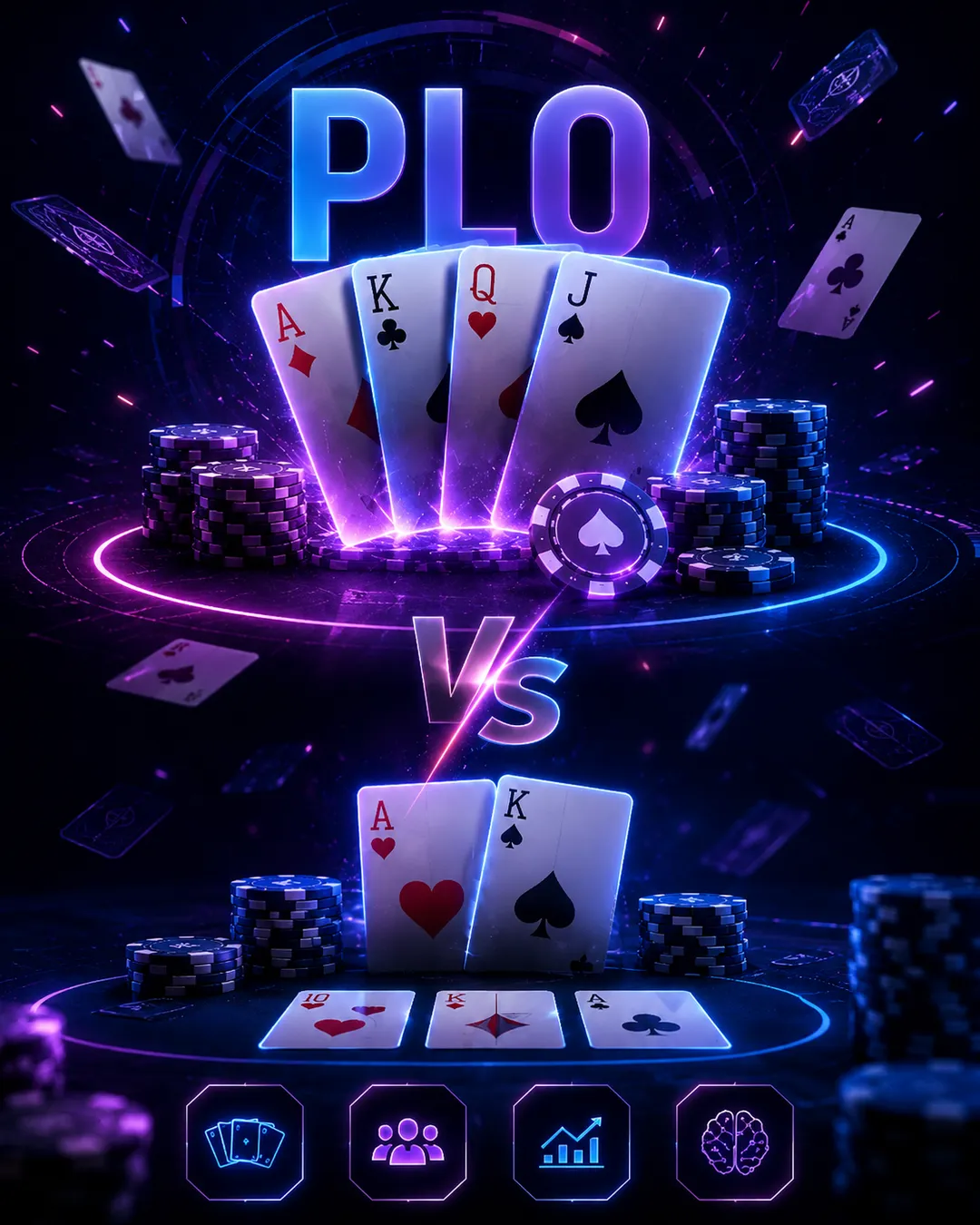
If you've already got a handle on Texas Hold'em and you're hungry for a game with more action, Pot-Limit Omaha (PLO) is the natural next step. At first glance the rules look familiar, but reading hand strength in Omaha is a lot more involved, and that's exactly what makes it more exciting. In this no-nonsense guide we break down the four differences every beginner needs to understand before sitting down at a PLO table in online poker.
What Changes Going From Hold'em to Omaha
In Texas Hold'em you get two cards and can use one, both, or neither of them to build your best five-card hand. In Omaha the logic shifts in four core ways. Before we dig into each one, here's a side-by-side overview:
| Aspect | Texas Hold'em | Pot-Limit Omaha |
|---|---|---|
| Hole cards | 2 cards | 4 cards |
| Combination rule | Use 0, 1, or 2 cards | Use exactly 2 from your hand + 3 from the board |
| Betting structure | Usually No-Limit | Pot-Limit (max bet = size of the pot) |
| Average winning strength | Pairs and two pair win a lot | Usually needs a set, straight, or flush |
Difference 1: You're Dealt Four Cards, Not Two
This is the most obvious change. In PLO every player is dealt four hole cards instead of two. More cards mean more possible combinations: a single starting hand can hold several straight and flush draws at the same time. The upside is that you'll connect with the flop far more often. The part that trips up beginners is that your opponents have stronger hands too, so hands that looked great in Hold'em are worth a lot less here.
Difference 2: The 'Two + Three' Rule Is Mandatory
This is where Hold'em players make the classic mistake. In Omaha you must use exactly two of your four hole cards and exactly three community cards from the board. No more, no fewer.
A practical example: imagine the board shows four hearts and you hold only the ace of hearts in your hand. In Hold'em that would be a nut flush. In PLO it is not a flush, because you'd need two hearts in your hand to complete the suit. Burn this rule into your memory before anything else, it's the number one source of misplayed hands for beginners.
Difference 3: The Bet Cap Is the Size of the Pot
The name gives it away: Pot-Limit. Unlike No-Limit Hold'em, where you can shove all-in at any moment, in PLO the maximum bet is capped at the amount currently in the pot. That completely changes the rhythm of a hand.
- Pots build more gradually, in layers, instead of blowing up all at once.
- You rarely risk your entire stack on a single pre-flop decision.
- The 'pot bet' calculation includes your own call before raising, so the maximum bet is bigger than most people think.
- There's more room for draws, which makes position and pot control even more important.
Difference 4: Winning Hands Run Stronger
Because everyone has four cards, the hands that win at showdown are, on average, much stronger. Two pair, which often takes the pot in Hold'em, is frequently a loser in PLO. To win big pots you usually need a solid set, a straight, a flush, or better. The practical takeaway is simple: respect the nuts (the best possible hand) and be wary of medium-strength hands, because they pay off the winner far more often than they do in Texas Hold'em.
Quick Tips for Your First PLO Hands
- Favor 'connected' starting hands: four cards that work together (like double-suited J-T-9-8) are worth far more than four loose cards.
- Be careful with lone aces; A-A-x-x with no connection loses value fast in multiway pots.
- Play in position whenever you can, it's worth its weight in gold in a game full of draws.
- Aim for the nuts, especially on flushes and straights, and avoid the 'second-best hand,' which is the most expensive trap in PLO.
- Start at low cash-game stakes to get comfortable with the 'two + three' rule without putting real pressure on your bankroll.
Where to Practice PLO Online
WPT Global runs Pot-Limit Omaha tables across a range of stakes, alongside Texas Hold'em tournaments and cash games, making it a great spot to switch between the two formats while you learn. You can fund your account with card, e-wallet, or crypto deposits, and withdrawals are handled quickly. It's worth checking out the welcome bonus and the rakeback terms before you start, so you get the most out of every dollar you deposit.
Start at low-stakes tables, apply the 'two + three' rule on every hand, and watch how the average strength of showdowns climbs compared to Hold'em. Within a few sessions PLO stops feeling confusing and becomes, exactly as promised, the most exciting format in online poker.
Operation and Licensing
WPT Global is operated by Everstronglink Limited, based in Costa Rica, licensed by the Tobique Gaming Commission under licence no. 0000005. The payment agent is Kashxa Limited, based in Cyprus, registration no. 427606. Games are strictly for players aged 18+. Please play responsibly.